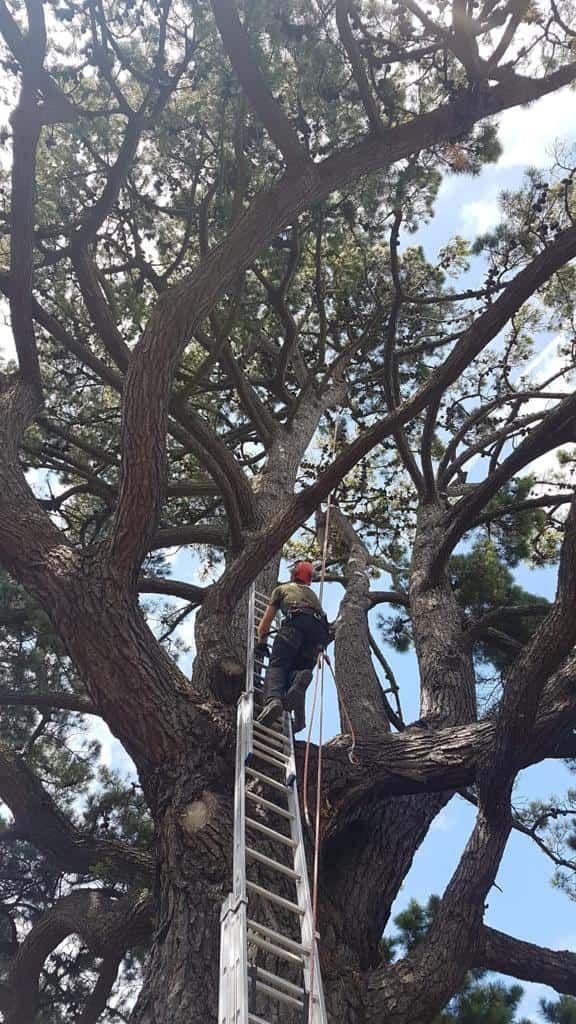
A tree can gradually become much larger than expected as its crown continues to develop year after year. Long branches may extend further across the garden, the upper canopy can become increasingly dominant, and a tree that once fitted comfortably within its surroundings may begin to feel oversized. This does not automatically mean that removing the tree is the appropriate solution.
Crown reduction is a professional tree surgery technique used to reduce the overall height, spread or both dimensions of a tree’s canopy. Rather than removing the entire tree, selected branches are carefully shortened back to appropriate growth points, with the aim of retaining a natural and balanced crown.
For homeowners in Weybridge, Surrey, crown reduction can sometimes provide a practical way of managing an overgrown tree while allowing it to remain part of the garden. Whether it is suitable depends on the tree’s species, maturity, condition, structure and the reason its size has become a concern.
How Can Crown Reduction Help Manage an Overgrown Tree?
Crown reduction involves selectively shortening branches throughout appropriate parts of the canopy rather than simply cutting the top from the tree. The objective is to create a smaller crown while retaining a suitable branch structure and sufficient healthy foliage.
The amount of reduction should be determined by the individual tree. Excessive pruning can substantially alter its structure and may encourage undesirable regrowth, which is why professional crown reduction is generally measured rather than severe.
When correctly planned, the work can help bring an oversized tree into a more manageable relationship with the surrounding garden without automatically resorting to felling.
An Overgrown Tree Does Not Automatically Need Removing
Tree size alone is not necessarily a reason for felling.
A large tree may still be in suitable condition and have a sound structure despite becoming inconvenient within its surroundings. If the main concern is excessive height or spread, pruning options can often be considered before removal.
Crown reduction is one of the techniques that may allow an established tree to remain while addressing its excessive dimensions.
Crown Reduction Can Reduce Overall Height
Some trees gradually develop substantial upper growth.
Where appropriate for the species and condition of the tree, selected upper branches can be shortened to reduce the overall crown height. This does not mean cutting every branch to exactly the same level.
Individual branches are assessed so that suitable pruning points can be selected throughout the crown.
Excessive Crown Spread Can Also Be Reduced
Height is not always the main problem.
Branches may extend a considerable distance across a garden even when the tree’s overall height remains acceptable. Long lateral growth can make the crown feel disproportionately large for the available space.
A reduction can focus partly or predominantly on spread where this is the principal concern.
Crown Reduction Can Address Both Height and Spread
Some overgrown trees have simply become too large in every direction.
In these situations, a carefully planned reduction may shorten selected growth around much of the outer crown. The aim is to create a smaller overall canopy without unnecessarily removing the tree’s main structural framework.
The appropriate extent of reduction depends on what the tree can reasonably accommodate.
Long Lateral Branches Can Make a Tree Feel Oversized
A small number of long branches can sometimes create most of the problem.
They may extend noticeably beyond the rest of the canopy or occupy a disproportionate amount of garden space. Where the remainder of the tree is reasonably sized, selective branch reduction may be sufficient.
This is why assessing individual branches is important before deciding that the entire crown needs substantial work.
Uneven Growth Can Sometimes Be Managed Selectively
Trees do not always grow evenly.
One side of a crown may become more extensive because of available light, surrounding space or previous pruning. This can create an appearance of excessive or unbalanced growth.
Professional pruning can focus on the relevant sections while avoiding unnecessary removal from parts of the crown that are already appropriate.
Crown Reduction Is Different From Tree Topping
A proper crown reduction should not be confused with indiscriminately cutting the upper branches from a tree.
Topping can leave large branches ending abruptly at unsuitable points and may remove a substantial proportion of the canopy without respecting the natural branch structure.
Crown reduction is more selective, with cuts made at appropriate branch positions to retain a coherent framework.
The Objective Is Not to Create a Perfectly Symmetrical Tree
Natural trees rarely develop into perfectly uniform shapes.
Light, surrounding vegetation and available growing space all influence the crown. Professional reduction therefore does not necessarily attempt to create artificial symmetry.
The aim is to achieve a proportionate reduction while respecting the natural characteristics of the tree.
Suitable Pruning Points Matter
Where branches are shortened is extremely important.
A crown reduction should not involve making arbitrary cuts simply to achieve a predetermined height. Branches need to be assessed individually so that suitable remaining growth can continue to form part of the canopy.
Skilled branch selection is central to good crown reduction work.
The Tree’s Species Influences What Is Appropriate
Different tree species respond differently to pruning.
Their natural growth habits, branch structures and responses to reduction can vary considerably. A level of pruning that may be appropriate for one species should not automatically be applied to another.
Species identification therefore forms an important part of planning crown reduction.
Tree Maturity Should Be Considered
Young and mature trees should not necessarily receive the same treatment.
A mature tree has spent many years developing its crown and main structural branches. Removing large quantities of established growth can represent a significant intervention.
For this reason, mature trees often benefit from particularly careful and proportionate decision-making.
Tree Condition Comes Before Size Reduction
Before considering how much smaller a tree should become, its overall condition needs to be assessed.
Dead branches, damaged limbs, cavities, previous pruning and other structural features may influence the work that is appropriate. Sometimes these issues need attention independently of crown size.
A professional assessment considers condition and dimensions together.
Deadwood Removal and Crown Reduction Are Different Operations
An overgrown tree may also contain dead branches, but these are separate issues.
Deadwood removal involves dealing with branches that have died, while crown reduction focuses on shortening suitable live growth to decrease canopy dimensions.
Where both are required, the work can be planned together while recognising the different objectives.
Previous Pruning Can Affect the Current Crown
Many overgrown trees have been pruned before.
Older cuts can influence how subsequent growth develops. In some cases, numerous shoots may emerge around previously shortened branches, eventually creating dense or rapidly extending sections.
Understanding this history can help determine how the tree should be managed during the next pruning cycle.
Heavy Previous Cutting Can Produce Vigorous Regrowth
Severe pruning does not necessarily make a tree easier to manage permanently.
Some trees respond to substantial cutting by producing vigorous new shoots. These can develop quickly and may eventually create another dense, oversized crown.
A measured reduction can therefore be preferable to repeatedly cutting the tree back as heavily as possible.
More Reduction Is Not Necessarily Better
It can be tempting to request the maximum possible reduction so that the tree remains smaller for longer.
However, excessive removal can be counterproductive. The tree’s species, condition and existing structure should determine how much crown can reasonably be reduced.
Professional tree surgery is about appropriate pruning rather than simply removing the greatest possible quantity of growth.
A Modest Reduction Can Still Make a Noticeable Difference
Crown reduction does not always need to be dramatic to improve how a tree relates to its surroundings.
Shortening selected outer branches can reduce the visual dominance of the canopy and create more separation from nearby garden areas.
The finished tree may remain substantial while feeling considerably more proportionate within the available space.
Staged Crown Reduction May Sometimes Be Appropriate
Where a tree has become particularly large, trying to achieve the desired size through one severe intervention may not be the best approach.
Depending on the individual tree, a more gradual management strategy can sometimes be considered. This allows the response to pruning to be observed before further work is planned.
The decision should be based on the tree rather than following a standard timetable.
Crown Reduction Can Help With Garden Space
Large crowns can occupy a significant amount of usable outdoor space.
Long lower or lateral branches may extend over seating areas, lawns or other parts of the garden. Where appropriate, selective reduction can create additional separation while retaining the tree.
This can be particularly useful when the tree remains valued but its dimensions have become inconvenient.
Lower Branches May Need Different Treatment
Not every size problem is located in the upper crown.
Sometimes lower branches are responsible for restricting movement or occupying too much space. In these circumstances, selective pruning of specific branches may be more suitable than reducing the entire canopy.
Identifying where the problem actually exists helps prevent unnecessary work.
Crown Reduction Can Improve the Relationship Between Tree and Garden
Trees and gardens change considerably over time.
A young tree may have been entirely appropriate when originally planted but become increasingly dominant as its crown matured. At the same time, the way the surrounding garden is used may also have changed.
Crown reduction can sometimes help restore a more practical relationship between the established tree and the space around it.
Excessive Upper Growth Can Be Brought Back Into Proportion
Some trees develop strong upper growth that makes the crown appear increasingly tall.
Where the structure and species are suitable, selective reduction can shorten this upper framework while retaining appropriate lateral growth.
The objective is not simply to flatten the top of the tree but to reduce height through careful branch selection.
Reduction Can Help Manage Overextended Branches
Branches that extend significantly beyond the main canopy can become increasingly prominent.
Selective shortening can bring these branches closer to the overall crown outline. This may improve both the practical dimensions and general proportions of the tree.
In some cases, managing a relatively small number of overextended branches may achieve much of the required improvement.
Crown Reduction and Crown Thinning Are Not the Same
These two tree surgery techniques have different objectives.
Crown reduction decreases the external dimensions of the canopy. Crown thinning selectively removes appropriate branches from within the crown without necessarily making the tree substantially shorter or narrower.
If excessive size is the main concern, thinning alone may not provide the desired outcome.
General Pruning May Sometimes Be Enough
Not every overgrown-looking tree requires a complete crown reduction.
If only a few branches have become excessively long, selective pruning may provide a more proportionate solution. A professional assessment can determine whether the complete crown genuinely needs reducing.
Using the least extensive suitable intervention can help retain more of the natural canopy.
Crown Reduction Can Sometimes Improve Light Around a Garden
Reducing selected outer growth can change how much of the surrounding area is occupied or shaded by the canopy.
However, crown reduction should not be viewed simply as a method of removing as much foliage as possible. The amount of pruning needs to remain appropriate for the tree.
Where light is the main concern, the structure and density of the crown should be assessed before deciding which technique is most suitable.
Future Growth Should Be Considered
Crown reduction changes the current dimensions of a tree, but it does not stop future growth.
Trees remain living organisms and will continue developing after pruning. The speed and pattern of regrowth depend partly on species, maturity, condition and the amount of material removed.
Homeowners should therefore view crown reduction as tree management rather than a permanent method of keeping a tree at exactly one size.
Good Reduction Considers How the Crown Will Develop Afterwards
The quality of tree pruning should not be judged solely on how the tree looks immediately after work is completed.
Branch selection should also consider future growth. Appropriate pruning points can help retain a more coherent framework from which the canopy can continue developing.
This long-term perspective is an important part of professional tree management.
Repeated Heavy Reduction Can Create Management Problems
If a tree is severely cut back each time it grows, repeated intervention may create increasingly complicated branch structures.
Vigorous shoots can develop around old pruning areas, potentially creating dense regrowth that requires further management.
Where ongoing pruning is necessary, a considered approach can help avoid repeatedly creating the same problem.
Regular Assessment Can Help Keep Growth Manageable
A tree does not necessarily need pruning every year.
However, occasional assessment can identify when certain branches are beginning to extend excessively or when previous reduction growth requires attention. Managing suitable growth before the crown becomes extremely oversized can sometimes make future intervention more straightforward.
Assessment should determine whether work is actually necessary.
Crown Reduction Is Not Suitable for Every Tree
Although crown reduction can be highly useful, it should not automatically be applied to every large tree.
The species, health, structural condition and existing branch framework all influence whether reduction is appropriate. In some circumstances, another form of pruning may provide a better solution.
Professional assessment is therefore important before deciding on the operation.
A Poorly Positioned Tree May Need Broader Consideration
Sometimes the underlying problem is not simply that a tree has become overgrown.
A tree may have matured in a location that provides very limited space for its natural dimensions. If substantial repeated reductions would be required to keep it within an unsuitable position, the longer-term management options may need broader consideration.
This does not mean removal should automatically be chosen, but the practical situation should be assessed realistically.
Crown Reduction Can Help Retain Established Trees
One of the principal advantages of crown reduction is that it can sometimes address excessive size without losing the entire tree.
Established trees can provide substantial visual character within a garden. Where their condition and position remain suitable, proportionate pruning can allow them to be retained while managing their dimensions.
The key is determining whether reduction genuinely provides an appropriate solution for the individual tree.
Tree Removal Should Not Be the First Assumption
When a tree begins to dominate a garden, felling may seem like the simplest solution.
However, removal is not always necessary. Crown reduction, selective pruning or management of particular overextended branches may provide enough improvement to resolve the main concern.
Exploring suitable pruning options first can help avoid removing a tree that could reasonably remain.
Professional Assessment Helps Avoid Unnecessary Pruning
A professional tree surgeon should assess what needs to be removed as well as what should remain.
Sometimes a homeowner may believe the whole tree requires substantial reduction when only a few branches are creating the problem. In other situations, the crown may genuinely have become oversized.
Condition-led assessment helps ensure the extent of pruning matches the actual issue.
Why Professional Crown Reduction Adds Value
Crown reduction requires more than simply making a tree smaller. Individual branches need to be assessed, suitable pruning points selected and the overall structure considered so that the remaining crown retains an appropriate form.
At NS Tree Surgery Weybridge, we assess the species, maturity, condition, branch structure and surroundings of the tree before recommending the extent of any reduction. The aim is to manage excessive growth proportionately while retaining as much suitable healthy crown as reasonably possible.
For trees in Weybridge, Surrey, this approach can provide a practical alternative where an established tree has become oversized but removal is not necessarily required.
The Best Solution May Be Less Work Than Expected
A large tree can appear to require extensive cutting when viewed from ground level.
Closer assessment may show that the problem is concentrated within several long branches or one overextended section of crown. Selectively managing these areas can sometimes provide a significant improvement without reducing the complete tree heavily.
Good tree surgery is not measured by how much material is removed, but by whether the work achieves the intended objective appropriately.
Conclusion
Crown reduction can make an overgrown tree more manageable without removing it when excessive height, spread or overextended branches are the main concerns and the tree remains suitable for retention. By selectively shortening appropriate branches, the overall dimensions of the canopy can be reduced while retaining much of the established tree.
The correct amount of reduction depends on species, maturity, condition, previous pruning and crown structure. Heavy cutting is not automatically better and can sometimes encourage vigorous regrowth, which is why a proportionate approach is important.
If an established tree at your property in Weybridge, Surrey, has become too large for its surroundings, contact NS Tree Surgery Weybridge. We can assess the tree and determine whether crown reduction, selective pruning or another appropriate tree surgery approach could make it more manageable while retaining it where suitable.
Call us on: 01372 679 098
Click here to find out more about NS Tree Surgery Weybridge
Click here to complete our contact form and see how we can help with your tree needs.